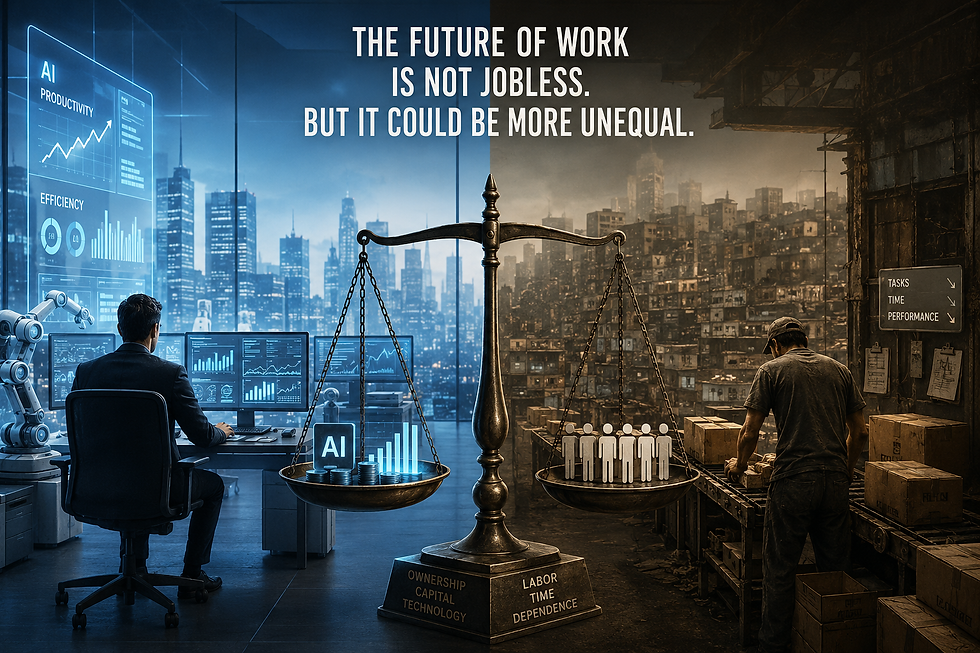
The future of work is not jobless but it could be more unequal

Every major leap in artificial intelligence brings with it the same prediction: machines are on the verge of replacing human workers.
The imagery associated with this scenario is familiar. Empty offices, fully autonomous factories, software that writes its own code, machines handling both physical and intellectual labor. Human employment fades away simply because there is little left for people to do.
This outcome is possible in theory, but it is probably not the most likely one.
A jobless future is unlikely. What is far more plausible is a future in which people keep working, while artificial intelligence reshapes the value of their skills, the conditions they work under, and how the wealth they help create gets distributed.
So the real question isn't simply whether AI will eliminate jobs.
It's whether the productivity AI generates will be shared widely, or concentrated in the hands of those who own and control the technology.
Jobs Are More Likely to Change Than to Disappear
Artificial intelligence rarely automates an entire profession in one stroke.
It automates individual tasks.
A lawyer doesn't perform a single activity called "legal work." A lawyer researches case law, reads documents, drafts arguments, talks to clients, negotiates, interprets regulations, and takes on professional responsibility for the outcome.
A cybersecurity analyst investigates alerts, examines logs, correlates threat intelligence, communicates risk to stakeholders, makes operational calls, and responds to incidents.
A doctor gathers information, interprets symptoms, reviews the medical evidence, talks with patients, chooses a treatment, and remains accountable for what happens next.
AI can perform some of these individual tasks very well without being able to replace the profession as a whole.
That distinction matters, because being exposed to AI is not the same thing as being made redundant by it.
The International Labour Organization estimates that roughly one in four workers worldwide holds a job with some degree of exposure to generative AI. Yet because most occupations still depend on human judgment, the ILO considers transformation far more likely than outright replacement.
This suggests the most common effect of AI won't be immediate job loss. It will be an expectation that workers get more done in less time.
A researcher might review hundreds of documents instead of dozens. A programmer might ship code faster. An administrative employee might absorb a workload that once required several colleagues.
The job stays. What changes is what's expected of it.
Productivity Gains Don't Distribute Themselves
Technological progress is often sold as a straight line to greater prosperity.
If machines let a society produce more with less effort, it seems only logical that people would work fewer hours, earn more, or enjoy greater economic security.
But productivity gains don't automatically flow to workers.
Picture a company where five employees carry out a given function. The company adopts an AI system that lets a single employee produce what the whole group used to.
The organization now faces a choice.
It could keep all five employees and cut their hours substantially. It could raise output while keeping the same headcount. It could move people into higher-value roles.
Or it could lay off four of the five, keep one, and expect that person to match the former team's output.
The technology is identical in every version of this story. What differs is who captures the benefit.
The first path turns automation into more freedom and security. The second concentrates the gains at the top while pushing the disruption onto workers.
Nothing intrinsic to the technology decides which path gets taken.
That's determined by ownership structures, competitive pressure, labor protections, tax policy, social safety nets, and how much bargaining power employees actually have.
A Positive Jobs Balance Can Still Mask Serious Disruption
Forecasts predicting that technology will create more jobs than it destroys are often used to wave away fears about automation.
The World Economic Forum projects that the economic and technological shifts expected by 2030 could generate around 170 million new jobs while displacing roughly 92 million — a net global gain of about 78 million positions.
On the surface, that sounds reassuring.
But a positive aggregate number doesn't guarantee a smooth or fair transition.
The people who lose their jobs won't necessarily be the ones who land the new ones. Those new roles may sit in different sectors, countries, or cities. They may demand qualifications the displaced workers don't have, or they may not materialize until years after the old jobs are gone.
An administrative worker whose role gets automated doesn't suddenly become an AI engineer. A junior designer replaced by generative tools doesn't automatically pivot into robotics. A translator, accountant, or customer-service worker may need substantial retraining without the time or money to pursue it.
The statistics can show job creation at the level of an entire economy while hiding real disruption at the level of individual lives.
A labor market can expand overall and still grow less secure for millions of people within it.
AI May Shrink the Path Into a Career
One of the least-discussed risks concerns how people get started in a profession at all.
Many of the tasks best suited to generative AI happen to be the ones traditionally handed to junior employees:
drafting first versions of documents;
summarizing material;
doing basic research;
writing routine code;
organizing information;
reviewing standard cases;
putting together reports;
running preliminary analysis.
These tasks can look repetitive, but they serve a real purpose: they're how inexperienced workers learn the profession.
A junior analyst becomes a senior one by running basic investigations, making mistakes, getting feedback, and gradually taking on harder cases.
A junior developer learns by debugging, reading other people's code, and building small components before ever designing complex systems.
If companies automate away a large share of this entry-level work, they may cut short-term costs while quietly dismantling the pipeline that produces their future experts.
Organizations could end up facing a strange paradox: needing experienced professionals while having eliminated most of the roles through which that experience was traditionally built.
The labor market of the future may hold fewer conventional career ladders — a smaller pool of highly capable workers amplified by AI, and a harder climb for newcomers trying to gain the practical experience needed to join them.
Those Who Keep Their Jobs May Face More Pressure
AI doesn't need to replace a worker to weaken that worker's position.
It only needs to make them easier to measure, easier to replace, or easier to supervise.
Algorithmic management systems already assign tasks, build schedules, track activity, evaluate performance, and feed recommendations into managerial decisions. A 2025 OECD survey found these tools were already in wide use across the countries it examined, though adoption levels varied considerably from one country to the next.
These systems can genuinely improve coordination and give managers better information. They can also open the door to new forms of surveillance and work intensification.
A worker may stay employed while losing more and more control over:
which tasks they're assigned;
how fast they're expected to complete them;
how their performance gets measured;
when they're allowed to take a break;
which decisions they're permitted to make;
whether an algorithm judges their output good enough.
The OECD has flagged concerns around rising work intensity, worker-data collection, privacy, shrinking autonomy, and inequality inside AI-enabled workplaces.
That points toward a future where AI raises productivity while making some jobs more draining.
An employee equipped with AI might do the work that used to take several people. But that same employee may also face higher targets, constant evaluation, and the ever-present sense that the organization believes fewer people are needed.
The result isn't unemployment across the board.
It's employment under a different balance of power.
AI Will Amplify Expertise Unevenly
AI won't touch every worker the same way.
For some, it will act as an extraordinary amplifier.
A highly skilled engineer using AI might complete work that once demanded an entire team. An experienced doctor might process information faster. A cybersecurity analyst might correlate far more technical evidence. A researcher might test hypotheses at a pace that was previously out of reach.
These workers may become more valuable precisely because they have the expertise to check AI's output, catch its errors, supply context, and take responsibility for the final decision.
Other workers may see the opposite effect.
Where a profession consists mostly of standardized digital tasks, AI could push down the market value of that work. Employers may need fewer people, offer lower pay, or shift the work to less experienced staff propped up by automated tools.
That could split the labor market into:
people whose abilities are amplified by AI;
people whose work is directed and monitored by AI;
people whose routine skills are devalued by AI;
people who lack the access, education, or infrastructure to benefit from any of it.
The dividing line won't simply run between technical and non-technical workers.
Increasingly, it will run between those who can supervise, validate, and direct automated systems, and those whose work can be fully defined by those same systems.
Ownership Will Shape the Outcome
The most consequential divide may not be between humans and machines.
It may be between those who own the advanced machines and those who have to sell their labor in a market those machines have reshaped.
If AI systems remain expensive, concentrated, and controlled by a small number of organizations, their owners stand to capture an outsized share of the resulting productivity gains.
Companies will be able to produce more with fewer employees. Investors may see higher returns. A relatively small group of specialists may command excellent salaries.
Meanwhile, displaced or devalued workers may find themselves competing for fewer openings.
Even people who stay employed may notice their bargaining power slipping. If a company can automate part of a job, or quickly train someone else with AI's help, that employee becomes easier to replace.
This is why the debate can't be reduced to a simple tally of jobs created versus jobs destroyed.
The deeper question is how income and productive ownership get distributed.
A society could grow considerably wealthier overall while most individual lives barely improve.
Economic growth and economic equality are not the same thing.
A Better Future Is Still Possible
None of this means AI has to widen inequality.
Artificial intelligence could take over dangerous and repetitive work. It could improve medicine, accessibility, education, science, public administration, cybersecurity, and environmental management.
It could let people produce more while working fewer hours.
But getting there would take deliberate choices.
Societies will have to decide whether productivity gains should mainly boost corporate returns, or also fund shorter working weeks, stronger public services, better social protection, and wider access to education.
Organizations will need to protect the paths through which junior employees build real experience.
Workers will need transparency about how automated systems monitor, evaluate, and make decisions that affect them.
Governments will need policy on competition, taxation, retraining, worker consultation, privacy, and accountability.
The ILO has stressed that this transition should be managed through social dialogue, so that productivity gains come paired with better working conditions — not instead of them.
That may be the central political challenge of automation.
The technical question is whether AI can take on more human tasks.
The social question is what happens to people once it does.
The Future Is Not Jobless
People will likely keep working for the foreseeable future.
Some will work because machines simply can't do what they do. Others will work alongside AI. Some will supervise machines, repair them, check their output, or take responsibility for the decisions they make.
Many will keep working simply because access to income, housing, healthcare, education, and security is still tied to having a job.
So the future of work probably won't be defined by the disappearance of labor.
It may instead be defined by a new hierarchy of labor.
A relatively small group may own the systems. Another group may use those systems to become extraordinarily productive. A much larger group may work under systems that measure, direct, and evaluate nearly everything they do.
Others may find the economy still needs them, just at a lower price than before.
AI could help build a society where people work less and live with more security.
Or it could build one where fewer people are needed, the ones who remain face more pressure, and most of the gains flow upward.
Both futures are technologically possible.
What decides between them won't be how intelligent the machines become.
It will be the choices made by the people and institutions that own them.


Commenti